How to Choose the Best Form Fill Seal Machine?

Choosing the right Form Fill Seal Machine can shape product quality, labor efficiency, and long-term operating costs. It is not simply a purchase based on speed or price. The machine must match the product, film structure, pouch format, sealing temperature, and planned production volume. A powder, liquid, and fragile snack each behave differently during filling. Small details matter.

Jorge Izquierdo, Vice President of Market Development at PMMI, emphasizes, “The best packaging equipment supports reliable production, efficient changeovers, and consistent quality.” This principle is practical. A machine that runs quickly but produces weak seals is not a strong investment. Inspect the sealing jaws. Watch the film path. Ask how operators clean contact surfaces and adjust forming tubes. These physical checks often reveal more than a polished brochure.

Consider accuracy, speed, footprint, controls, safety features, and technical support together. Review actual samples from your production line, not only laboratory demonstrations. Test the intended film, especially when recycled or lightweight materials are involved. Measure seal strength, fill accuracy, waste, and changeover time. Service response also deserves attention. A delayed replacement part can stop an otherwise excellent line.

There is no perfect machine.

A common mistake is choosing capacity that the current team cannot manage. Another is ignoring future package sizes. I have seen specifications look impressive until operators face difficult threading or unclear controls. That experience should encourage careful questioning. Compare total ownership costs, training requirements, maintenance access, and supplier expertise before deciding. The best Form Fill Seal Machine is the one that performs consistently in your real facility, with your materials, people, and production goals.
How to Choose the Best Form Fill Seal Machine?

Understanding Form Fill Seal Machine Types and Applications

How to Choose the Best Form Fill Seal Machine?

Understanding the machine type comes before comparing speed or price. Vertical form fill seal machines create bags from a film roll, then fill and seal them in a compact footprint. They suit powders, grains, snacks, and many free-flowing products. Horizontal machines handle pouches, bars, medical packs, and products needing gentle, controlled placement. Intermittent-motion systems often support precise dosing. Continuous-motion systems usually deliver higher output.

Application decides the correct architecture. A dusty powder may need auger dosing, dust extraction, and sealed guarding. Granules often require multi-head weighing for better accuracy. Fragile products need softer transfer and shorter drops. Liquid products demand pumps, anti-drip nozzles, and reliable seal-temperature control. Small details matter.

According to PMMI’s 2024 packaging automation report, labor availability remains a major reason companies invest in automation. Mordor Intelligence estimates the form fill seal machine market will grow at over 5% annually through the late 2020s. These figures suggest continuing demand, but they do not choose a machine for you. A fast machine can waste material if film registration drifts. A low-cost model may also create expensive changeover delays. This is where practical trials help. Test the real product, film, fill weight, and target speed. Record seal strength and reject rates. The result may challenge the original specification. That is useful.

Defining Your Packaging Material, Product, and Production Requirements

How to Choose the Best Form Fill Seal Machine?

Defining your packaging material, product, and production requirements should guide every machine decision. In plant evaluations, film behavior often creates more problems than machine speed. Test seal strength, coefficient of friction, thickness, and stiffness before requesting quotations. Polyethylene, laminated films, and recyclable mono-materials may require different sealing temperatures and jaw pressures.

According to PMMI’s 2023 Packaging Machinery Shipments Study, U.S. packaging machinery shipments reached approximately $10.2 billion in 2022, rising 9.1%. That growth reflects strong investment, but faster equipment is not automatically better.

Your product also determines the forming system. Powder can bridge inside the funnel, while oily snacks may weaken seals. Fragile products need gentler timing and controlled drop heights. Dusty products may require wider sealing areas and improved cleaning access.

Measure target weight, fill volume, product density, and acceptable giveaway. The 2023 Food Packaging Forum report highlights growing attention to material recyclability and chemical safety, so packaging goals should be defined before machine selection.

Production data must be specific.

Record bags per minute, operating hours, changeover frequency, staff skill, and planned growth. A machine rated at 120 bags per minute may deliver less in daily operation. Film splices, cleaning, rejects, and adjustments reduce actual output. Build a trial using your real film and product. A clean spreadsheet can still mislead. Sometimes, the cheaper machine needs more labor, space, and patience. Ask for measured uptime, seal-test results, and maintenance records rather than impressive speed claims.

Comparing Machine Features, Speed, Accuracy, and Automation Levels

How to Choose the Best Form Fill Seal Machine?

Choosing a form fill seal machine starts with the product, film, and required output. A dry powder needs different handling from fragile snacks or liquid products. Check the forming collar, sealing jaws, film path, and dosing system carefully. These parts influence package quality every minute. In practical trials, I inspect seal strength, film tracking, and changeover time. A clean seal should remain firm after pressure testing. Small wrinkles often reveal poor temperature control or uneven tension.

Speed matters, but useful speed matters more than the number shown on a brochure. Compare stable production rates under real conditions, including film changes and cleaning. Servo-driven motion can improve timing and reduce mechanical waste. However, advanced controls do not correct poor setup. Accuracy depends on the filling system, load cells, sensor response, and product flow. Ask for weight variation data from several production runs. One short test is not enough.

Automation level should match operator skill and maintenance support. Automatic film splicing, recipe storage, fault alerts, and reject tracking can reduce routine errors. Remote monitoring may help, but clear local diagnostics remain essential. I have seen highly automated equipment slow down because operators could not find a basic fault. That weakness deserves attention. Select a machine with accessible components, documented settings, and measurable service procedures. Allow time for training and validation. Real factories are less predictable than demonstrations.

Evaluating Hygiene, Maintenance, Safety, and Regulatory Compliance

How to Choose the Best Form Fill Seal Machine?

Evaluating Hygiene, Maintenance, Safety, and Regulatory Compliance

A reliable form fill seal machine should protect the product from contamination during every production shift. Look for stainless steel contact surfaces, smooth welds, and minimal hidden corners. These details make cleaning faster and reduce residue buildup. In practical use, operators should inspect sealing jaws, film paths, and filling nozzles daily. A clean design matters more than impressive output speed.

Tips: Request a cleaning demonstration before purchase. Check whether tools are needed. Review spare-part access and maintenance instructions. Keep inspection records, even when the process seems routine. Small omissions can become expensive failures.

Safety requires guarded moving parts, emergency stops, clear warning labels, and simple operator controls. Test these features during acceptance trials, not after installation. The machine should support documented procedures for cleaning, inspection, calibration, and changeover. Confirm that materials and processes fit the regulations in your target markets. Requirements can differ, so qualified compliance advice is valuable. I would not trust a certificate alone; actual operating evidence matters. A perfect machine does not exist. Choose one that makes safe, hygienic work easier every day.

How to Choose the Best Form Fill Seal Machine?

Practical evaluation weighting for hygiene, maintenance, safety, and regulatory compliance

The weighting is a practical purchasing framework rather than a legal requirement. Hygiene focuses on cleanable product-contact areas and hygienic equipment design; maintenance covers accessibility, changeover time, spare parts, and preventive servicing; safety considers guarding, risk reduction, and control-system reliability; regulatory compliance includes applicable food-contact, machinery-safety, and site quality requirements such as FDA 21 CFR Part 117, EU Regulation (EC) No. 1935/2004, ISO 14159, and ISO 13849-1. Confirm the final priorities with the intended product, packaging material, process hazards, and local regulations.

Calculating Total Ownership Cost and Selecting the Right Supplier

A form fill seal machine should be judged by total ownership cost, not its purchase price. The U.S. Department of Energy estimates that motor-driven systems consume about 69% of industrial electricity. A 12 kW machine running 4,000 hours annually therefore uses roughly 48,000 kWh. At $0.12 per kWh, electricity alone costs about $5,760 each year. Add film waste, compressed air, maintenance, labor, tooling, software updates, and planned downtime.

PMMI’s 2024 State of the Industry report identifies labor availability and automation as important packaging investment drivers. That supports a practical supplier test. Ask for documented changeover times, measured seal consistency, spare-parts availability, and service response targets. Request a factory acceptance test using your actual film, product dimensions, and production speed. A two-hour demonstration is not enough. Insist on production data.

Compare five-year costs using the same assumptions. Include installation, training, preventive maintenance, energy, consumables, rejected packs, and lost production hours. Suppliers should provide references from similar applications, not only impressive brochures. Check whether technicians are local and whether critical parts have realistic lead times.

The calculation will be imperfect. Film prices change. Operators also vary. That is why sensitivity testing matters. Model energy prices 20% higher and output 10% lower. The cheapest quotation may then become the most expensive option. A supplier who explains these risks clearly is usually more reliable than one promising “zero downtime.”

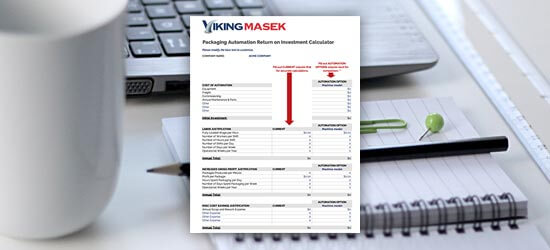
Packaging machine ROI calculator

Need help figuring out if packaging automation is right for your business?


First, start with the numbers. Download our free packing machine ROI calculator to learn how long it will take for an investment in automation to pay for itself (and much more).


Free packaging automation ROI calculator